UK Apple Cider Vinegar - Raw, Pure, Unpasteurised, Made From Naturally Grown Apples.
| Item | Qty | Price |

Home»Apple Cider Vinegar
:: Natural Apple Cider Vinegar - Main Page

» What Is Apple Cider Vinegar?
Apple Cider Vinegar has been used in cuisine and medicine since ancient times. It is a product of fermented apple juice. Apple Cider Vinegar can be produced in a number of different ways, from the slow going traditional methods that can take over 2 years to the quick 3 month fermentations as used by commercial producers. Our ACV is made the old way, which makes for an authentic, traditional smooth tasting natural product.
Apples are well known to be good for us, containing all manner of nutrients, including pectin, vitamins, fibre and minerals, hence the expression "an apple a day keeps the doctor away".
» Apple Cider Vinegar - Why is Traditional Better?
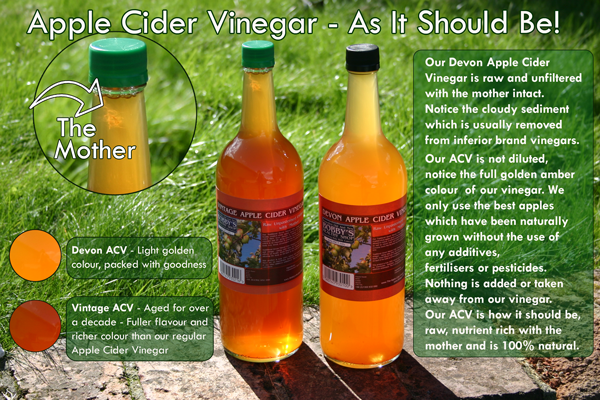
Many of the apple cider vinegars that you will find in the health food shops and supermarkets have been pasteurised and filtered. This destroys and removes the 'Mother' (a ball of living enzymes that floats in the apple cider vinegar) and other nutrients. Also many of these vinegars are made from apples grown using harmful chemical fertilizers and pesticides.
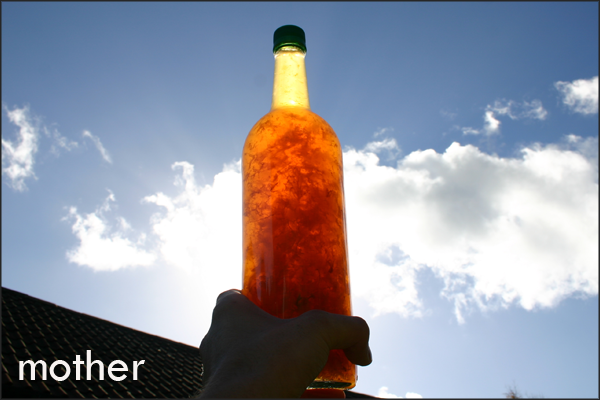
Our Apple Cider Vinegar is made from hand picked, naturally grown apples, and contains absolutely no additives! The ACV is in its natural state, meaning that the 'Mother' is intact. This ball of living enzymes is largely responsible for many of the properties of the vinegar. You can get the 'Mother' in your bottle to grow by leaving it in the sunlight.
¦¦ Most Popular ACV Products:
Click here to view our full range of Apple Cider Vinegar products
» ACV Questions & Answers:
What is Natural Apple Cider Vinegar? (ACV)
What is the ‘Mother’?
Why is traditional ACV not pasteurised?
Naturally grown apples, does that mean organic??
How long will my ACV keep?
How should I store my vinegar?
Is it ok to eat the ‘Mother’?
Will taking ACV affect any medications that I am taking?
Is Apple Cider Vinegar safe to give to children?
Is it safe to take ACV when pregnant?
What ingredients is Apple Cider Vinegar made from?
I am concerned about plastics, why do you use some plastic containers?
Does Apple Cider Vinegar contain alcohol?
How should I take my apple cider vinegar, can I take too much?
What is the pH of apple cider vinegar?
ACV and pH
Cyder Vinegar – Cider Vinegar, what is the difference?
The Benefits Of Apples In General
The Mineral Content Of Apples
What is Natural Apple Cider Vinegar? (ACV)
It is a traditional product made from freshly crushed, hand picked apples that have been allowed to mature naturally without heat. Unlike all commercial types of ACV, natural apple cider vinegar is not processed or refined and has had nothing added or taken away. Natural ACV is cloudy and contains sediment. It also contains a substance called the ‘mother’ which is naturally produced during the fermentation process.
[back to top]
What is the ‘Mother’?
The ‘Mother’ is essentially enzymes, a natural substance created during the fermentation process of ACV. It appears as a cob-web like formation floating in the vinegar. The ‘mother’ is alive and is made up from bacteria, enzymes and living nutrients. Many brands of ACV remove this formation, as to many it would appear that something is wrong with the vinegar. The presence of the mother shows that the vinegar has not been processed or filtered.
[back to top]
Why is traditional ACV not pasteurised?
Pasteurisation is a process that uses heat in order to kill undesirable micro organisms and bacteria that can spoil many consumable liquids. This process also destroys many nutrients and enzymes present in the product. Natural ACV has many properties meaning that it is not necessary to pasteurise and doing so would destroy the ‘mother’. The ‘mother’ is largely responsible for the main effects. Therefore pasteurised and processed apple cider vinegar (which you will find in most health-food shops and supermarkets) will lose many of its attributes.
[back to top]
Naturally grown apples, does that mean organic?
Our Apple Cider Vinegar has been produced using the same old traditional methods that have been practised for many hundreds of years. The apples are grown without the use of any chemicals, so no fertilisers or pesticides! They are then gathered by hand and washed in fresh water before pressing in small batches. The process is completely natural and is very similar to organic standards. Nothing is added or taken away and no chemicals are used in any stage of production, from apple blossom to bottling. Because some of the old orchards we use are not certified for organic growing we cannot call our vinegar organic but be rest assured that it is 100% natural and free from additives.
[back to top]
How long will my ACV keep?
Your vinegar cannot ‘go off’. It will mature over time which will improve the flavour and will develop the mother. We allow our Devon ACV to mature for at least three years, while our vintage variety has been maturing for over a decade. It's extra age refines the flavour and it develops a deeper golden colour.
[back to top]
How should I store my vinegar?
Your ACV should be stored in a cool, dark place away from direct sunlight. Light promotes growth of the mother and over time it will continue to form. Our ACV is a natural product and the mother content can vary from bottle to bottle so if you feel you would like more mother in your ACV then you can store it in the light. Otherwise store it in a cupboard and it will keep indefinitely.
[back to top]
Is it ok to eat the ‘Mother’?
Yes, the mother is safe to eat. It is recommended that you give your bottle of ACV a shake before use to break up the mother formation to ensure even distribution.
[back to top]
Will taking ACV affect any medications that I am taking?
Apple cider vinegar is a completely natural product and is essentially just a food. If you are unsure if it is safe to take with medications ask your doctor or other licensed healthcare professional.
[back to top]
Is Apple Cider Vinegar safe to give to children?
As above, ACV is just a food. There is no reason why children should avoid consuming apple cider vinegar unless they have been advised by a healthcare professional to specifically not to.
[back to top]
Is it safe to take ACV when pregnant?
ACV has absolutely no side effects and is completely safe to use during / after pregnancy and while breastfeeding.
[back to top]
What ingredients is Apple Cider Vinegar made from?
Apples – Natural ACV should be made from nothing but apples. Nothing to be added, and nothing should be taken away (except a little yeast).
[back to top]
I am concerned about plastics, why do you use some plastic containers?
We have very carefully selected our plastic bottles to only be manufactured from 100% BPA free, non-leaching HDPE. We also offer glass bottles for those of you who still concerned about the use of plastics.
[back to top]
Does Cider Vinegar contain alcohol?
Properly fermented apple cider vinegar should have a 0% alcohol content. This is why we allow our ACV to ferment naturally for at least two years. Unlike commercial manufacturers, we don’t rush, taking our time to produce quality traditional vinegar.
[back to top]
How should I take my apple cider vinegar, can I take too much?
We recommend taking three dessert spoons of ACV in a little warm water three times daily, at meal times if possible. It is very important to never mix your apple cider vinegar with hot water, as this will effectively pasteurise the vinegar.
Taking your ACV undiluted may cause some discomfort for some, so we recommend mixing it with purified water. We often take apple cider neat, straight from a shot glass, we like the no-nonsense approach. However, to start this may be un-comfortable. There are no set limits to the amount of apple cider vinegar you should take daily but drinking too much may make you feel a little queasy.
Mixing your apple cider vinegar with raw honey, or organic blackstrap molasses makes a lovely warm drink. Raw honey and organic blackstrap molasses are naturally rich in vitamins and minerals which are essential for general wellness. For more details on mixing your ACV tonic please click here: How to mix ACV
[back to top]
What is the pH of ACV?
As you probably already know, ACV is acidic. Because it is a natural product its pH can vary slightly from year to year. Typically the pH of apple cider vinegar is around 4.50 to 4.75.
[back to top]
ACV and pH?
The pH of a substance is a measure of its acidity or alkalinity. pH is short for potential of hydrogen and the scale ranges from 0 to 14. Neutral pH is 7 with 0 being the most acidic and 14 is the most alkaline.
It is a common misconception that foods that taste acidic are acid forming in the body. In fact some of the most powerful alkalising foods are very acidic. A good example of this are citrus fruits, they have a pH of around 2.5 to 3.5 yet are some of the most alkaline forming foods that you can eat.
[back to top]
Cyder and Cider - What is the difference?
There is no difference between Apple Cyder Vinegar and Apple Cider Vinegar. Traditionally ACV has been called both Cyder and Cider vinegar although the method and recipe are the same. Fermented pressed apples.
[back to top]
» The Benefits Of Apples in General
Did you know that there are approximately 7,500 cultivated varieties of apple worldwide? From the Aceymac apple to the Zuccalmaglio's Reinette apple, apple are a great fruit not only for their health benefits but for a whole range of other things too. Apples were traditionally a fruit that were eaten from the end of summer through to late autumn but nowadays apples can be accessed all year round. Today, apples are one of America's most popular fruits with each American eating roughly 65 apples per year.
Apples have been known to have been around since primordial times: Archaeologists have evidence of people eating apples as far back as 6500 B.C and it's been proven that sun-dried apples were consumed during the Stone Age. A great deal of Greek and Roman mythology refers to the apple as an emblem for love and beauty.
» The Mineral Content Of Apples
The saying "An apple a day keeps the Doctor away" has a whole lot of truth to it. Apples are a host to many vitamins, minerals, nutrients and compounds that make them a wholesome treat. The fruit contains a cocktail of antioxidants, including phloridzin, catechin, quercetin and chlorogenic acid. In addition, apples contain pectin, a beneficial soluble dietary fibre, and high levels of vitamin C and vitamin K.
In addition, eating an unpeeled apple raw is a good workout for the mouth, providing fibre, a massage for the gums and a mild cleaning for the teeth. At merely 80 calories per medium-sized apple, why not benefit from them as much as possible? There are enough reasons to regard the advice of the aforementioned proverb.
If you have any other questions about your apple cider vinegar please feel free to call us on 01884 35551 / +44 1884 35561
¦¦ All our ACV Products:
¦¦ Related Products:
» Apple Cider Vinegar - Further Reading On The Subject:
We cannot be held responsible for the content owned and updated by external websites.
There are numerous good websites for further information:
http://earthclinic.com/Remedies/acvinegar.html
http://www.bellaonline.com/articles/art8171.asp
http://www.bobbyshealthyshop.co.uk/Articles-And-Glossary.php
| Apple Cider Vinegar With Mother | Apple Cider Vinegar Benefits | Apple Cider Vinegar Candida |